


Description:
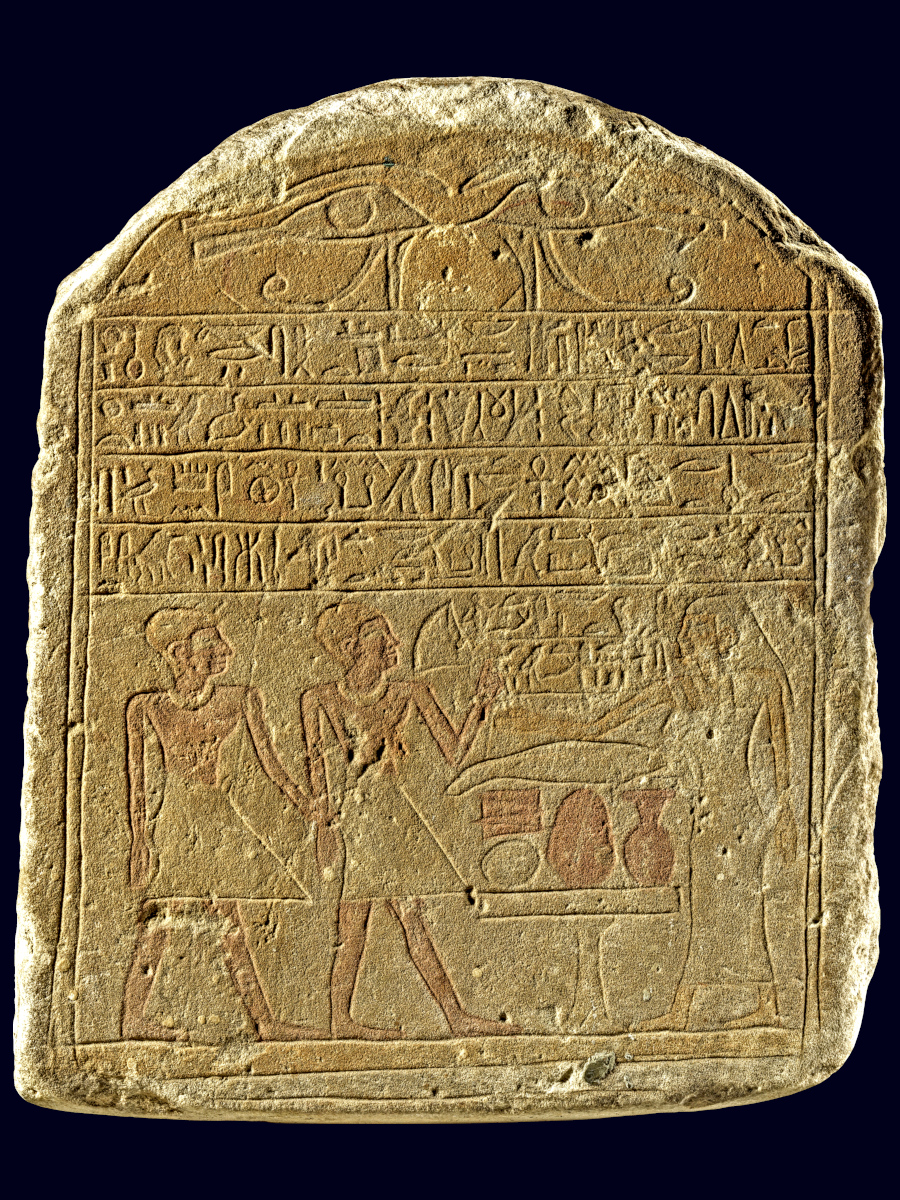
An important round-topped stela with remains of the original polychromy. It contains four elements, framed by an incised double line: a depiction in the lunette, the main hieroglyphic text, a dedication text, and a scene depicting three persons around an offering table.
The stela was made of sandstone, a fine-grained stone mainly consisting of quartz sand, originating from weathered rocks and compressed back into a compact whole, with small amounts of clay, calcium carbonate, iron oxide or silica. As opposed to limestone, the grainy character of sandstone gives the relief its typical soft contours.
Dating:
Middle Kingdom or shortly after, circa 2000-1600 B.C.
Size:
Height circa 52 cm.
Provenance:
Belgian private collection, acquired from Galerie Eberwein Ancient Art, Paris; before Swiss private collection, acquired in the 1970s. The object comes with a copy of the export license issued by the Ministry of Culture of the French Republic, as well as a copy of the German export license, documents from Galerie Eberwein Ancient Art and certificates from the Art Loss Register and the Interpol database.
Condition:
The stela shows some minor chipping and is slightly abraded; chipped around the edges; with remnants of the original polychromy.
Price:
On Request
Stock number:
E2502
Detailed description:
The lunette
The upper part of the stela, or lunette, is decorated with two wedjat eyes, symbols of divine protection. They have the shape of a human eye with a brow above and characteristic markings below in the form of a drop shape at the front and an uncurling spiral at the back, said to imitate the markings on the head of the lanner falcon.
In Egyptian mythology, the sun and the moon were believed to be the eyes of the falcon-headed god Horus the Elder, the celestial falcon and great creator god. However, there was also another god called Horus, who was the son of Osiris. He fought several battles with the evil god Seth, and during one of those battles, the eye of Horus was plucked out; later it was healed by Thoth, and from then on it was called wedjat, meaning "the sound one". The two originally separate myths were later blended, and it is possible that the waning and waxing of the moon was linked to the eye being injured and restored; however, in Egyptian texts the term was also used for the sun eye, and depictions of the wedjat can show both the left or the right eye.
In any case, because it was healed, the eye became one of the most powerful of all protective amulets. According to the Osiris myth, Horus offered the healed eye to his dead father, and so powerful a charm was it that it restored him to life. Similarly, funerary offerings were identified with the eye of Horus. For the wedjat eye see Andrews (1994), p. 10; 43-44.
The texts
In four lines of hieroglyphs, reading from right to left, we find an offering formula, which in almost all Egyptian texts from this period consists of four parts: the king's formula, the closely associated god's formula, the requests (specifying the nature of the offerings), and the names of the recipients of these offerings (compare Franke (2003), p. 39). Below the main text, in two short lines, just above the table with offerings, is the so-called dedication text.
The main text reads:
An offering that the king gives, and Osiris, the Lord of Abydos and the Lord of the Sacred Land, and Ptah-Sokar, who is beautiful of face,
... May they give an invocation offering consisting of bread, beer, oxen, fowl, alabaster, clothing, ointment, incense, food offerings, provisions,
and all good and pure things on which all gods live, for the ka of the officer of the city regiment Saamun, justified,
for the ka of ... Dedusebek, justified, and for the ka of the Lady of the House Teti, justified, the children of Kyt.
The king's formula
The formula "an offering that the king gives" reflects the Old Kingdom notion that the king theoretically could (or originally did) monopolise the giving of funerary offerings to private cults; it may even have gone so far as to indicate the permission of the king for the tomb to be in the necropolis (Strudwick (2005), p. 31).
The god's formula
"And Osiris": it has long been thought, based on grammatical details, that the expression indicated that the offering was given to the gods whose name is mentioned, so that they in turn could give the offering to the dead; in that case one would translate "an offering that the king gives to Osiris". However, a more recent view is that the offering is given by both the king and the gods together (Franke (2003), p. 39-57; Strudwick (2005), p. 31).
The requests
An invocation offering, in Egyptian perit kheru (with variations), literally "the going forth of the voice" was an offering that was spoken, either by a descendant of the deceased, ideally his eldest son, or by a priest contracted for the purpose (compare Strudwick, p. 31). The list of offerings would be read aloud, and this would provide, thanks to the magical power of the word, the items for the deceased. After all, hieroglyphs (in ancient Egyptian medu netjer, words of god) were given to humanity by the god Thoth and were therefore considered sacred. They were more than just writing, they could represent what they expressed. The concept was ubiquitous, see for example the creation myth of Memphis in which the god Ptah created things by speaking them into existence, or the notion that one could destroy an enemy by simply erasing his name.
For the funerary cult it meant that if no real offerings were made, either because one could not afford them, or because after some generations the cult had ceased to exist, the hope was that at least a list of offerings would be read aloud so that these offerings would turn into offerings that the deceased could use. Passers-by were often encouraged to do so. And if even this recitation would ever stop, the offerings would still come into being in a shape accessible for the deceased, thanks to the magical power of the writing.
The recipients
The offerings are meant for the ka of the persons whose name is mentioned. The ka was the creative life force of a person, sometimes depicted as that person's double. The ka came into existence at the moment of birth, and when a person died, his ka continued to exist, and needed to be fed; therefore food offerings were made to the ka, who was expected to partake of the life-giving force contained in those offerings; as the Egyptians expressed it: a person's ka would take to itself the ka of the offerings.
The persons for whom the monument was erected were three children of a woman called Kyt: the brothers Saamun en Dedusebek and their sister Teti. Without doubt these are the persons depicted in the lower register, although their names are not indicated there. For these personal names see Ranke (1935), 280, 22 (Saamun); 343, 13 (Kyt); 384, 4 (Teti); 402, 24 (Dedusebek).
Saamun was an officer of the city regiment (anx n niw.t); for this title see Ward (1982), p. 74, 604 (who still translates "citizen", now outdated); Quirke (2004), p. 100. The title of Dedusebek is unfortunately illegible. Their sister Teti was a Lady of the House, a common title for married women, indicating their responsibility for the daily operations of the household, encompassing domestic duties, childcare and overseeing servants.
The dedication text
The dedication text reads:
It is the bow keeper Itef (or It)
who causes the names of his ancestors to live.
This text tells us that the stela was dedicated by a man called Itef or It. He did this for his ancestors, who were no doubt the three children of Kyt. Although these were the beneficiaries, the dedicator himself would also benefit from erecting the monument and inserting his own name: even though he is not depicted (which is quite common with dedications), by including his name, that too was caused to live on. In addition the mention that he did this for his ancestors, which was considered a merit, guaranteed that Itef would gain favour, both with passers-by who would offer to him because of what he had done, and with the gods, ensuring a positive afterlife for himself.
The dedication (or rather vivification) formula makes its earliest appearance in texts from the First Intermediate Period, although it does not occur in significant numbers until the Middle Kingdom. Its usage increases even further during the New Kingdom, only to decrease dramatically after this period (Nelson-Hurst 2010, p. 13, referring to Grallert 2001, p. 98).
For the name Itef see Ranke (1935), p. 50, 13 (and p. 48, under no. 29 for the alternative reading It). For his title, bow keeper or bowman (iry-pD.t), see Ward, p. 63, no. 516; Quirke, p. 101.
The scene
Althought the names of the three persons depicted are not given here, there is no doubt that they are the ones mentioned in the main text. The two brothers both wear a necklace, and are dressed in a short kilt (shendit) which is depicted in a typically Egyptian, aspective way: the loincloths appear triangular, but this is in fact a combination of profile and frontal view, to show as many "aspects" of the clothing as possible; what appears to be a point in front, is a visual representation of the draping.
The same aspective way of representation is apparent when we look at the position of two men: one of them seems to be standing behind the other, but the image intends to show them standing side by side. One of them is smelling, or at least holding, a lotus flower.
The woman opposite them is their sister. She is wearing a long tight dress, and is reaching out to her brother(s) across the offering table between them, which is laden with food.
Bibliography:
- Carol Andrews, Amulets of Ancient Egypt (London, British Museum Press, 1994);
- Detlef Franke, "The Middle Kingdom Offering Formulas: A Challenge", Journal of Egyptian Archaeology, volume 89 (2003), p. 39-57;
- Silke Grallert, Bauen - Stiften – Weihen. Ägyptische Bau- und Restaurierungsinschriften von den Anfängen bis zur 30. Dynastie (Berlin, Achet Verlag, 2001);
- Melinda G. Nelson-Hurst, “‘…Who Causes His Name to Live’. The Vivification Formula Through the Second Intermediate Period” in Zahi A. Hawass - Jennifer Houser Wegner (eds.), Millions of Jubilees: Studies in Honor of David P. Silverman (Supplément aux Annales du Service des antiquités de l'Egypte, 39) (American University in Cairo Press, 2010), p. 13-31;
- Hermann Ranke, Die ägyptischen Personennamen, Band I (Glückstadt, 1935);
- Stephen Quirke, Titles and Bureaux of Egypt 1850-1700 B.C. (GHP Egyptology, volume 1) (London, Golden House, 2004);
- Nigel C. Strudwick, Texts from the Pyramid Age (Writings from the Ancient World, 16) (Atlanta, GA, Society of Biblical Literature, 2005);
- William A. Ward, Index of Egyptian Administrative and Religious Titles of the Middle Kingdom (Beirut, American University, 1982).