


Description:
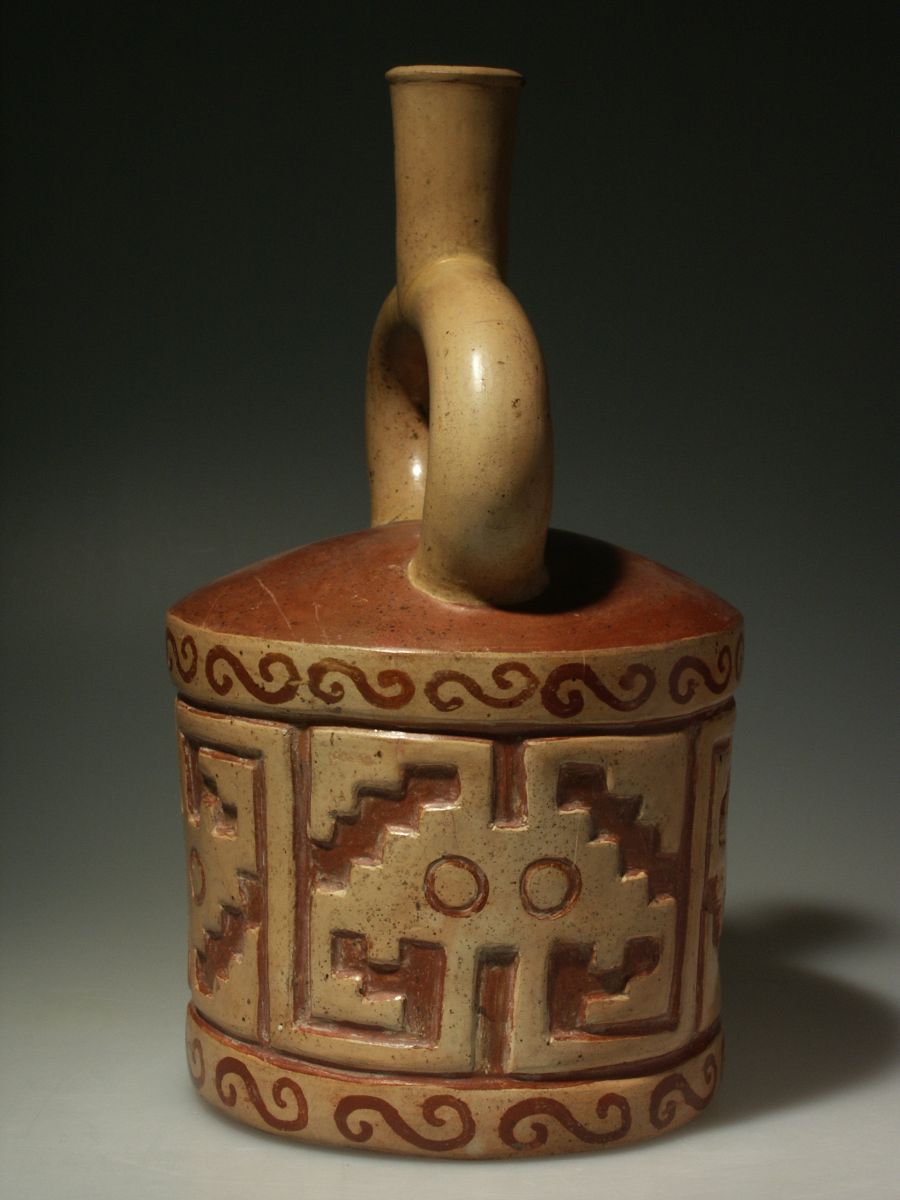
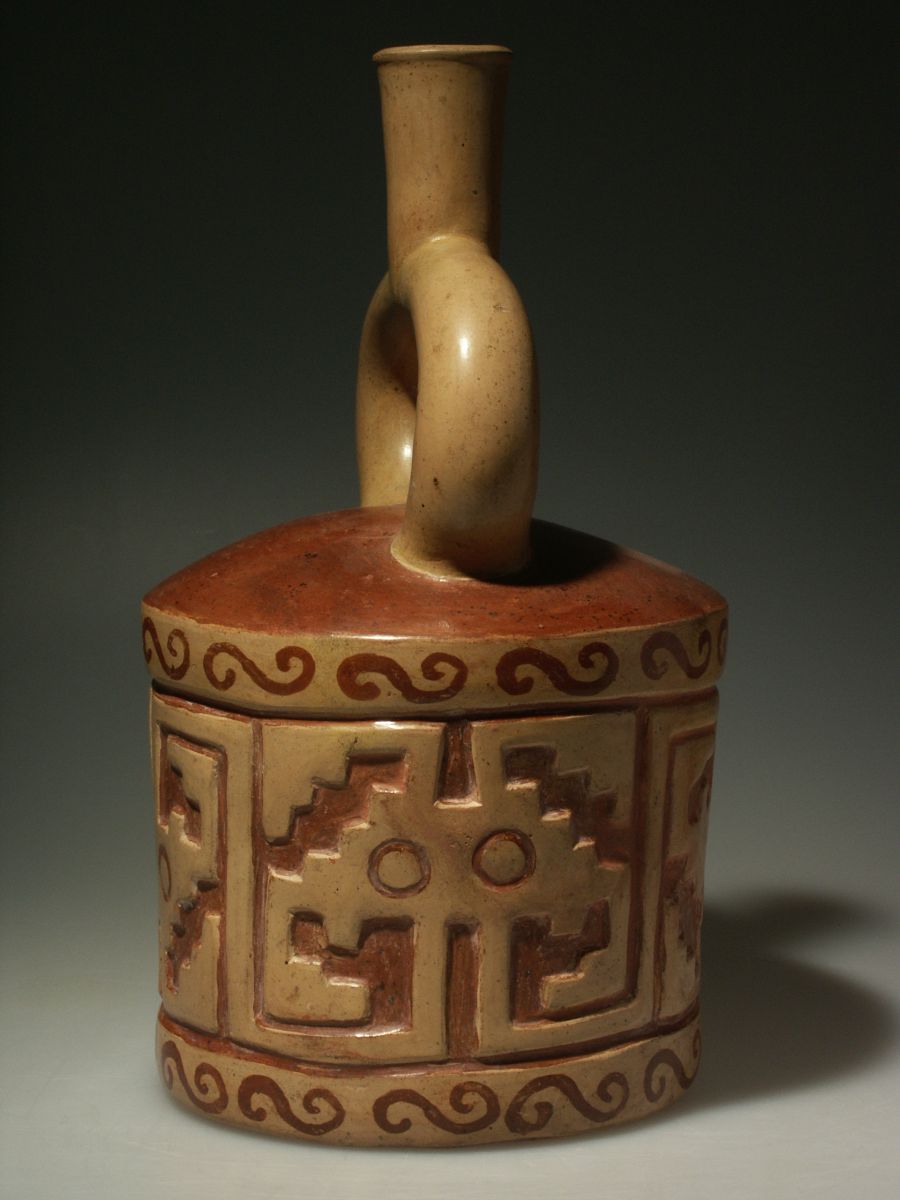
What a marvellous vessel! On the face of it this polychrome vessel, with its phenomenal use of colours - tan and red contrasting with the buff background - belongs to the group of geometrically decorated pottery. Several motifs occur repeatedly in this group. The most important ones are:
- The so-called step motif in which the hypotenuse of a triangle consists of steps (or a wavy line). These steps are probably a symbol for the mountain and/or the temple. Other triangles on such vessels are often filled in with small circles. A variant and extension is the step-wave motif. Here the vertical line of the triangle ends in a wave which curls either over the steps or backwards. The symbolism here is probably that of river water streaming down the mountains.
- The S-wave motif, which is used to indicate water but has also been explained as a fertility symbol.
- Many pots display still other geometric patterns, such as triangles, dots and spots, stars or concentric bands. Other pots have their surface divided into differently coloured planes.
Our vessel shows in S-wave in the top and bottom bands; the middle band, divided into panels, shows what appears to be the step motif, incised and supplemented by circles.
BUT: at the same time we are also dealing with a completely different motif, belonging to the zoomorphic representations. What we are looking at from this point of view is the symbolic representation of the head of a catfish. This animal, a freshwater fish which has a wide and flat head with the eyes on top and long feelers, is frequently portrayed on Moche pottery. Quite often the head alone, seen from above, is depicted and usually this is done by composing it of geometric designs such as the step motif, as in our case. The small circles represent the eyes and the vertical lines that divide the panels are the feelers. What at first sight appeared to be the buff background for the tan geometric decoration now suddenly becomes the foreground. Quite remarkable!
Catfish, living on the muddy bottom of water streams where they cannot easily be seen, were associated with the world of the dead, which was considered as an inverted, nocturnal, underground, or underwater realm (see Hélène Bernier, 2009; see below).
The ancient authenticity of the vessel was confirmed by a thermoluminescence test. A copy of the TL test report accompanies the object.
Literature:
For the geometric designs see Edward K. de Bock, Moche: Gods Warriors Priests (Series Collections of the Museum Volkenkunde, Leiden, no 2) (Leiden, Spruyt, Van Mantgem & De Does, 1988), p. 105 ff.; for the catfish motive ibid., p. 91 f.
For the catfish in Moche art see Hélène Bernier, "Dualism in Andean Art" in Heilbrunn Timeline of Art History (New York, The Metropolitan Museum of Art, June 2009).
Dating:
Moche III, circa 300-450 C.E.
Size:
Height 19.9 cm.
Provenance:
Private Dutch collection, purchased from Artemis Gallery; before that private US collection, acquired before 1970.
Condition:
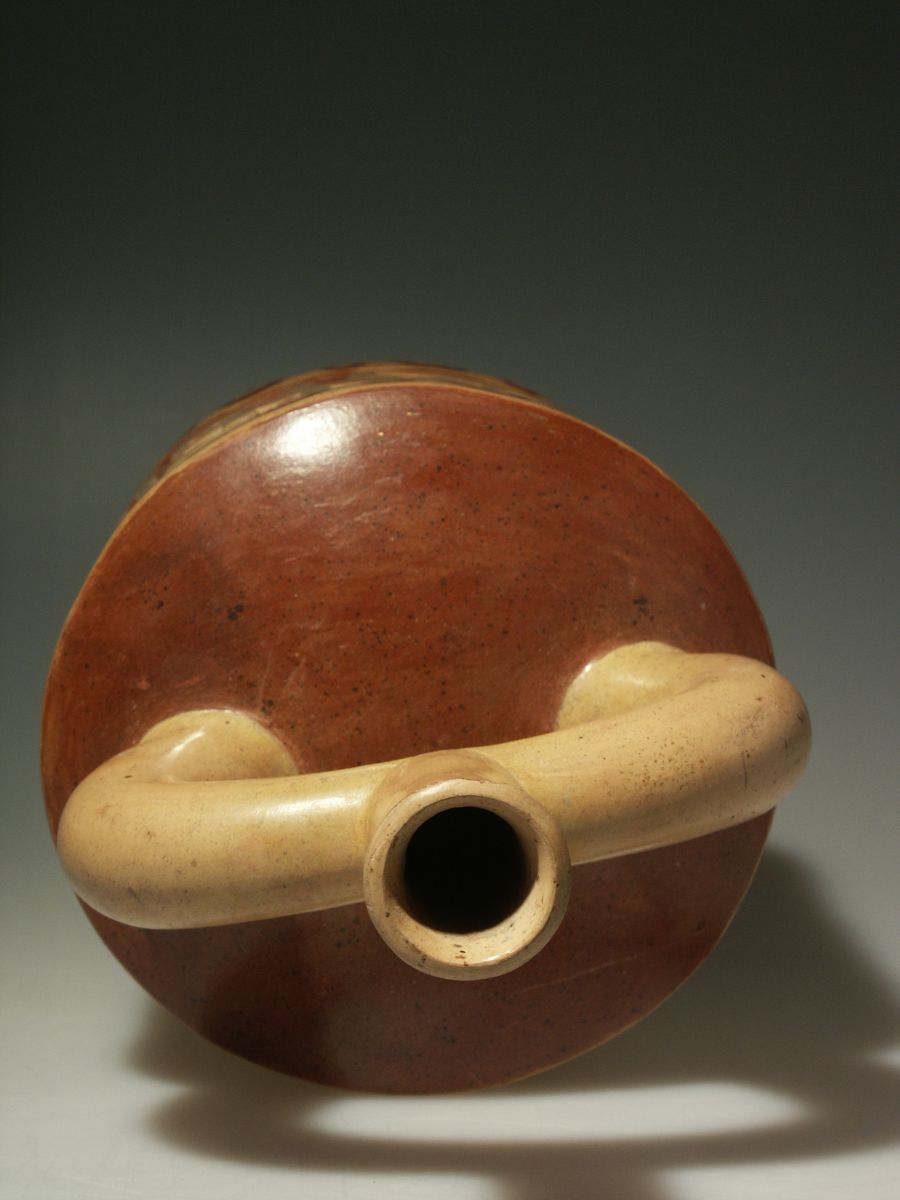
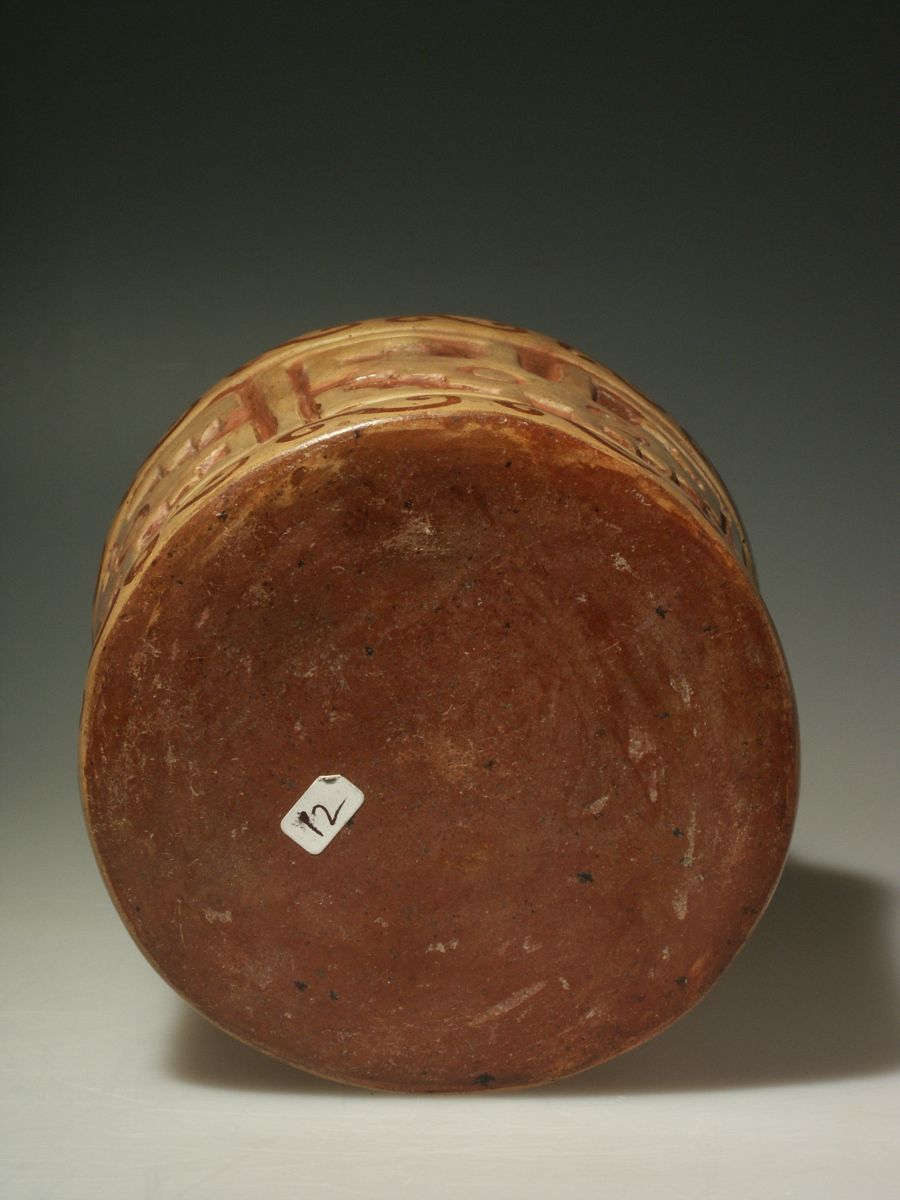
A few very minor repairs, done professionally and thus invisible; possibly a small amount of overpainting, because under a black light a couple of miniature spots light up a bit here and there, but this is almost impossible to detect, so it is hard to be sure. A few small scratches and a minor rim chip. Otherwise in excellent condition. The vessel appears choice and belongs to the finest pieces of Moche art, also because of the stunning use of colours. An old inventory sticker underneath. Two minuscule holes caused by taking a sample for the TL test.
Price:
€ 2,400
Stock number:
P0584