



Description:
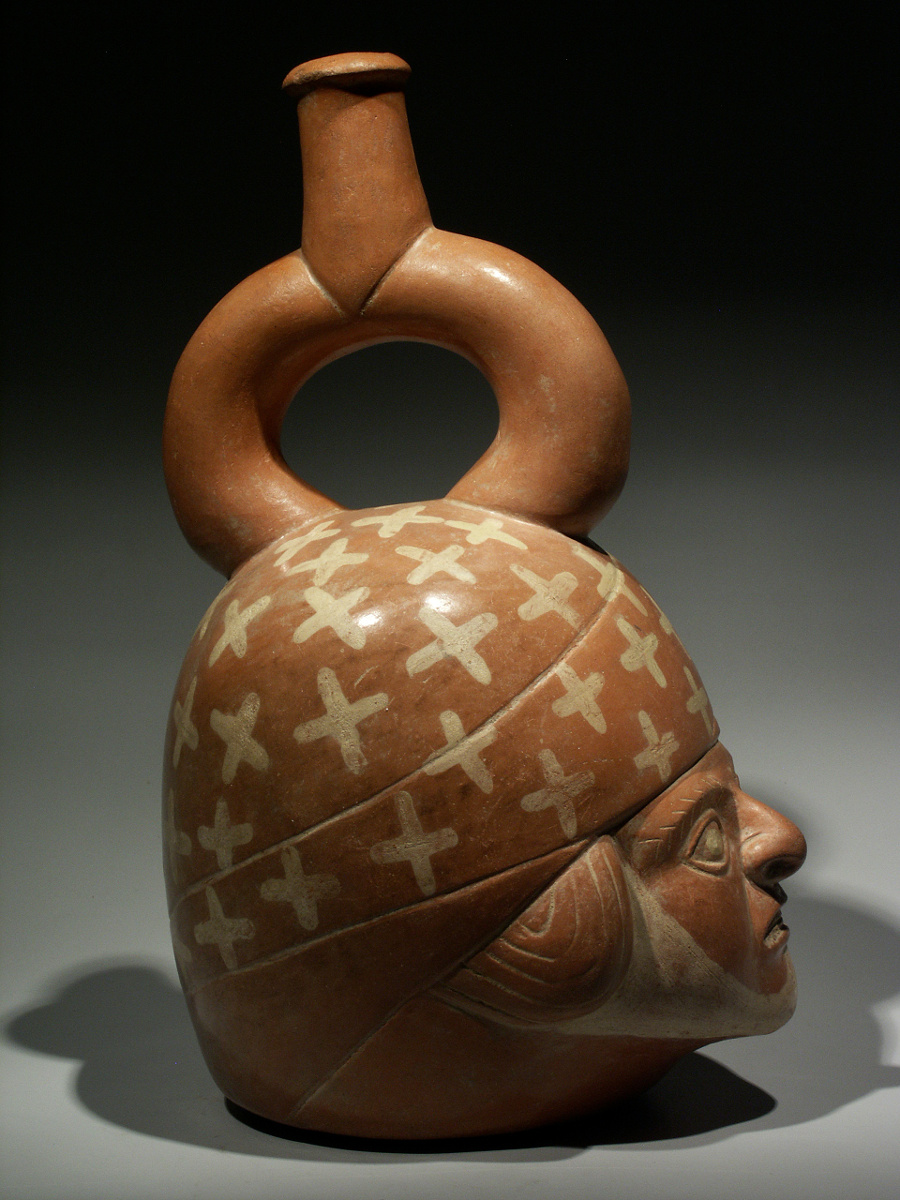
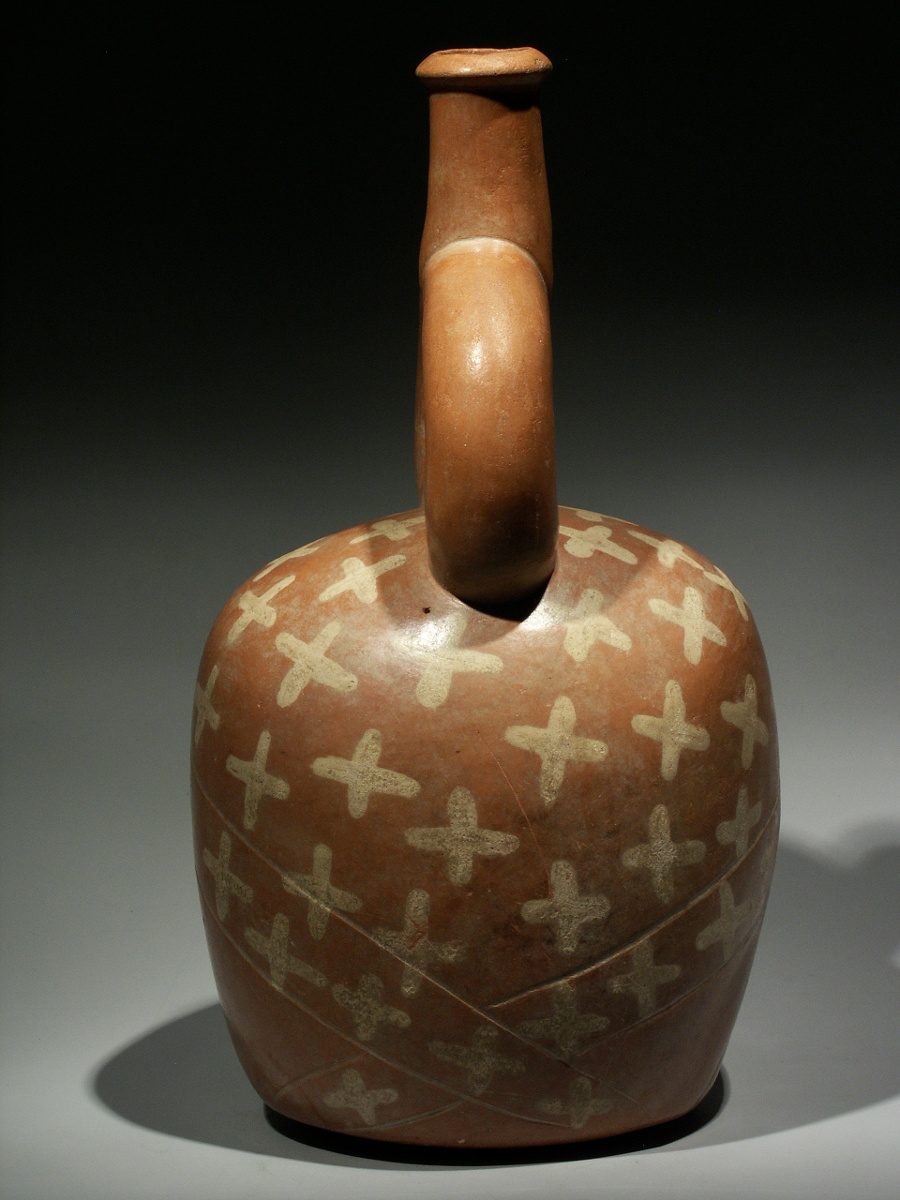
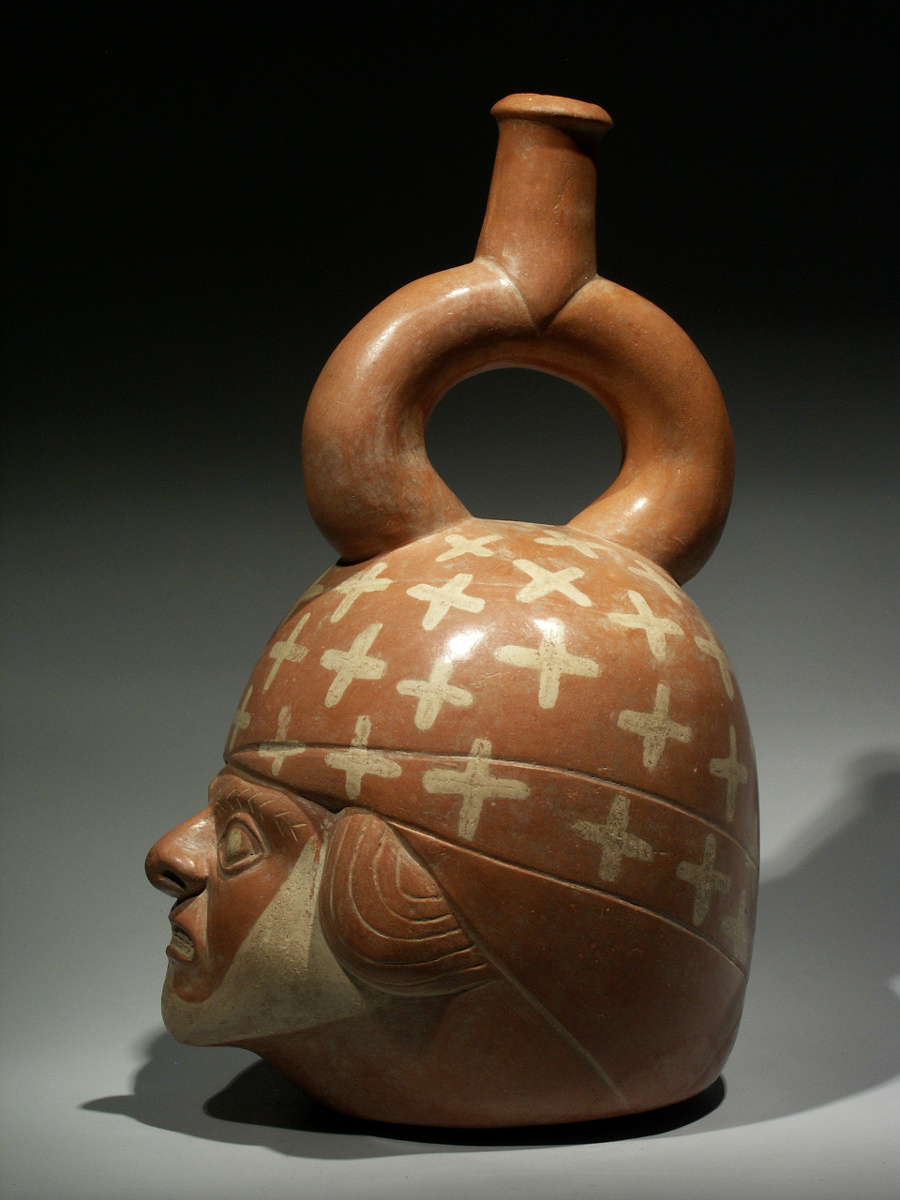
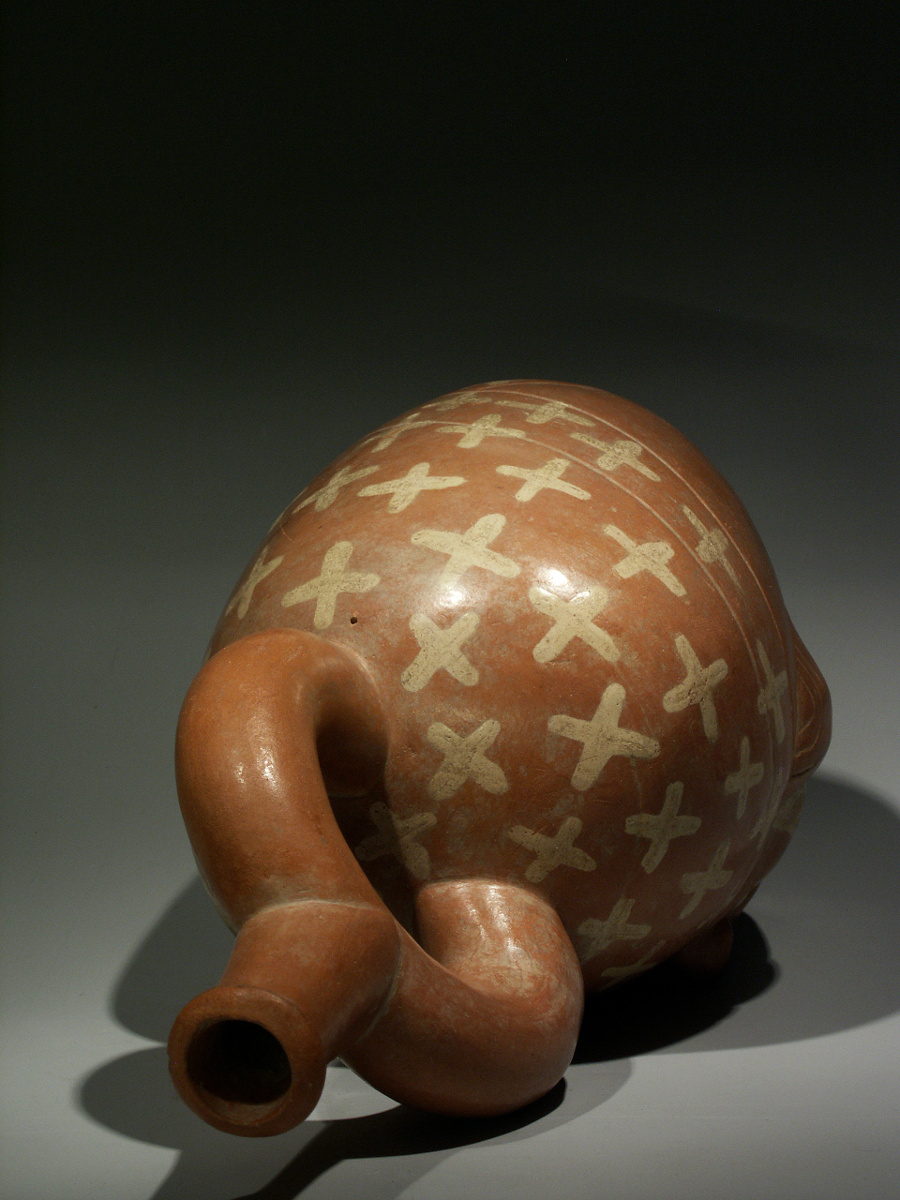
A marvellous and early terracotta vessel with a phase I stirrup spout, depicting the portrait of a man who is wearing a large, bound turban. His round face with well sculpted facial features shows the remarkable craftsmanship of the artist who created this vessel; details like the eyelids are shown in relief, the eyebrows are indicated by incisions; the face is painted in two colours.
The man depicted was possibly a shaman. This is indicated by the fact that he probably has been using some hallucinogen, as can be deducted from his grimacing face as well as his wide eyes with large pupils, but also from the decoration of his turban; the crosses are the symbol for the San Pedro cactus. The psychedelic nature of this plant was well known to the ancient Moche.
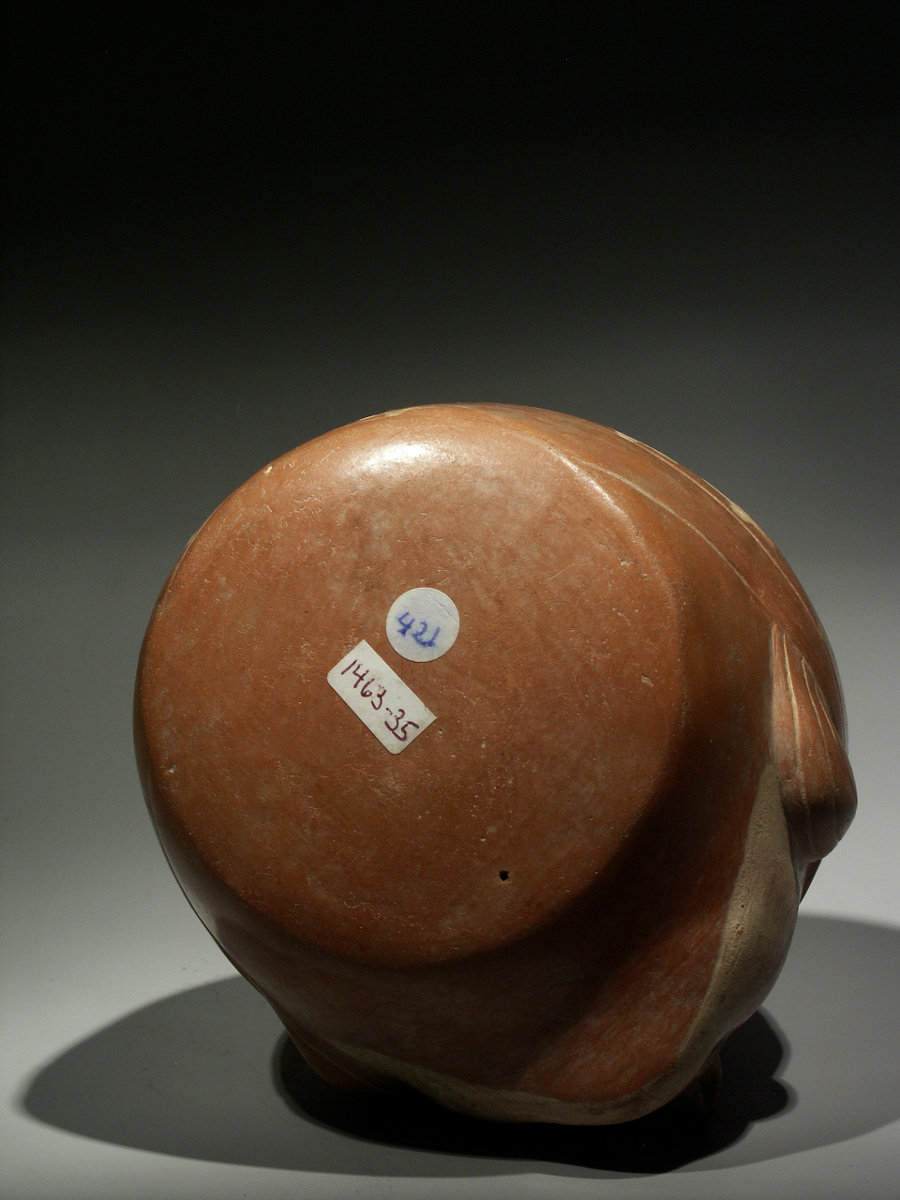
The ancient authenticity of the vessel was confirmed by a thermoluminescence test. A copy of the TL test report comes with the object.
Background information::
Possibly the best work about Moche portrait head vessels written so far is that by Christopher B. Donnan. To quote from his book:
"Only a few ancient civilizations actually developed true portraiture, showing the anatomical features of a person with such accuracy that the individual could be recognized without reliance on accompanying symbols or texts. Of all the civilizations that developed in the Americas prior to European contact, only one perfected true portraiture and produced it in quantity: the Moche" (Donnan 2004, p. 3).
"True portraiture was among the greatest achievements of Moche potters. They skillfully captured the facial features of specific individuals and instilled a lifelike quality in each portrait. Nearly all of the Moche portrait head vessels depict adult males, although some children are also shown. No truly lifelike portrait of an adult female has been identified. Some portrait head vessels show individuals with illnesses, or with abnormalities such as a missing eye or a harelip. As a group, the portraits represent and astonishing range of physical types. They allow us to meet Moche people who lived more than fifteen hundred years ago, and to sense the nuances of their individual personalities" (ibid., p. 9).
"Moche ceramic portrait vessels have been found in only a few of the Moche graves that have been excavated archaeologically. They occur in graves of both males and females - almost exclusively those of high-status individuals. When portrait heads are found in a grave, usually only one or two examples are present. This implies that they were not produced in great number and were seldom available to the common people. There is no evidence that portrait head vessels were ever buried with the individuals they depicted. Although nearly all the portraits are of adult males, they are sometimes found in female burials. Moreover, many portraits were often made of the same individual, and these were ultimately placed in the graves of various people" (ibid., p. 10).
Literature:
Christopher B. Donnan, Moche Portraits from Ancient Peru (University of Texas Press, 2004);
Marlene Dobkin de Rios, "Power and Hallucinogenic States of Consciousness Among the Moche, an Ancient Peruvian Society", in: Colleen A. Ward (ed.), Altered States of Consciousness and Mental Health: A Cross-Cultural Perspective (Newbury Park, California, Sage Publications, 1989), p. 285-299;
Rainer W. Bussmann - Douglas Sharon, "Shadows of the Colonial Past – Diverging Plant Use in Northern Peru and Southern Ecuador", Journal of Ethnobiology and Ethnomedicine 5 (2009);
Douglas Sharon, Shamanismo y el Cacto Sagrado. Evidencia Etnoarqueologica Sobre El Uso Del Cacto San Pedro En El Norte Del Peru = Shamanism and the Sacred Cactus. Ethnoarchaeological Evidence for San Pedro Use in Northern Peru (San Diego Museum Papers, 37) (San Diego Museum of Man, 2000);
Alana Cordy-Collins, "The Jaguar of the Backward Glance", in Nicholas J. Saunders (ed.), Icons of Power. Feline Symbolism in the Americas (London; New York, Routledge, 1998), p. 155-170, esp. p. 168 note 6 for the four-ribbed cactus.
Dating:
Moche I, circa 1st-2nd century C.E.
Size:
Height 23 cm.
Provenance:
Dutch private collection, acquired from Arte Primitivo, New York, 2005; previously in a prominent US private collection, 1960s.
Condition:
The stirrup spout has been reattached; small restoration to the nose; 2 small holes from the TL test; else in excellent condition.
Price:
€ 4,800
Stock number:
P0788